


Cape Town receives more sunshine per year than almost any major city in the southern hemisphere. The case for solar here is not built on fear of the grid failing. It is built on straightforward financial logic: Eskom tariffs have increased by over 400% in the past 15 years, the trajectory is not reversing, and a correctly sized solar system pays for itself and then generates value for the remaining life of the installation.
Cape Climate designs and installs solar systems for residential and commercial properties across Cape Town and the Western Cape. This page covers how the process works, what system types are available, what realistic costs look like, and what separates a well-designed installation from one that will cost you more over time.
The load shedding crisis accelerated solar adoption in South Africa significantly between 2022 and 2024. But the buyers coming to market now are operating on different reasoning. With Eskom’s supply position stabilising, the decision to go solar is increasingly driven by tariff economics rather than emergency energy security. Eskom’s average tariff has increased from approximately R0.50 per kilowatt hour in 2010 to over R3.50 per kilowatt hour in 2026. The National Energy Regulator of South Africa has approved further increases. A household consuming 1,000 kilowatt hours per month, which is modest for a home with an inverter air conditioner, is spending over R3,500 per month on electricity at current tariffs. A correctly designed solar system offsets the majority of that consumption during daylight hours and, with battery storage, extends that offset into the evening.
The return on investment calculation at current tariff levels is materially different from what it was five years ago. Systems that took 10 to 12 years to pay back in 2019 are paying back in five to seven years at 2026 tariff levels, with further tariff increases improving that figure annually. Beyond the financial case, a solar installation adds measurable value to a property. South African buyers and tenants increasingly factor energy independence into property decisions, and a compliant, well-documented solar installation is a quantifiable asset at the point of sale or lease.
Not every property needs the same system. The three main configurations available to Cape Town homeowners and businesses each suit a different set of priorities and budgets. A grid-tied system connects your solar panels directly to the municipal grid via an inverter.
During daylight hours, solar generation offsets your grid consumption directly. Surplus generation can be fed back to the City of Cape Town grid under the Small Scale Embedded Generation programme, earning a credit against your electricity account. Grid-tied systems are the most cost-effective entry point and suit properties where daytime consumption is high and the primary goal is reducing the monthly electricity bill. They do not provide backup power during a grid outage.
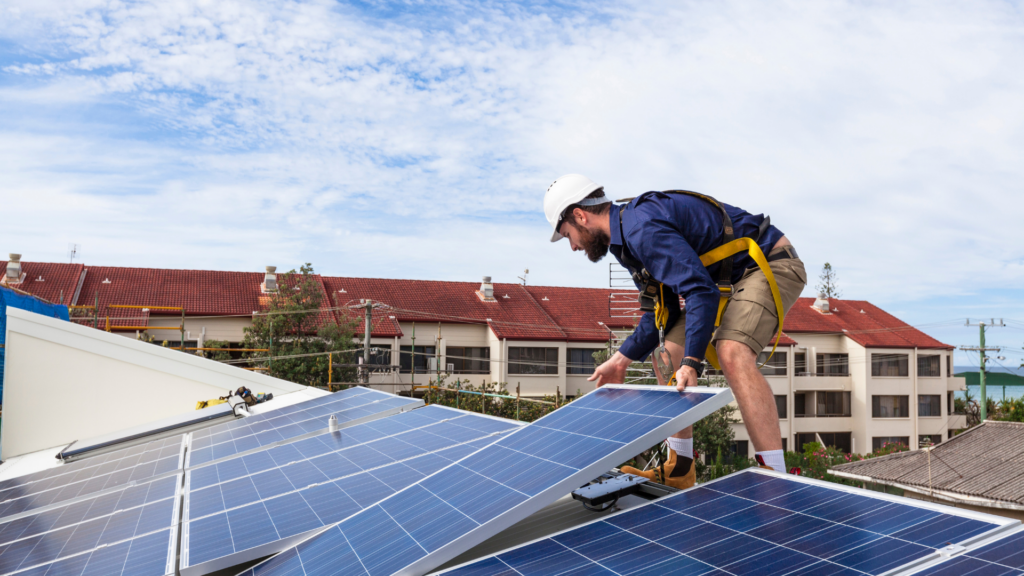
A hybrid system adds battery storage to the grid-tied setup. Solar generation charges the batteries during the day, and stored power covers consumption during the evening or during a grid outage. Hybrid systems provide the financial benefits of grid-tied solar with the added security of backup power. They represent the most popular configuration for Cape Town residential installations currently, balancing cost, performance, and security.
An off-grid system operates entirely independently of the municipal supply. These systems require significantly larger panel arrays and battery banks to cover all consumption across all conditions, including extended overcast periods. Off-grid installations are appropriate for rural properties without grid access or for commercial properties with specific energy independence requirements. They are generally not cost-effective for urban Cape Town residential properties with reliable grid access. Cape Climate will assess your property, your consumption data, and your priorities before recommending a system configuration. There is no universal answer, and a system sized incorrectly for your actual usage will either underperform or represent an unnecessary capital outlay.

Say goodbye to frustrating blackouts. Solar gives you energy independence, especially during load shedding.
Slash your monthly energy costs by harnessing the free power of the sun.
Use clean, renewable energy that reduces your household or business’s environmental impact.
Solar installations make homes and commercial buildings more attractive to buyers and tenants — a smart long-term investment.

From R135,000 Incl VAT

From R194,000 Incl VAT

From R243,500 Incl VAT

From R380,500 Incl VAT


Pricing transparency matters in a market where quotes vary significantly between suppliers. The ranges below reflect realistic installed costs for Cape Town residential properties in 2026, including panels, inverter, mounting hardware, wiring, and installation labour. A basic grid-tied system producing three to five kilowatts of peak output, suitable for a smaller home or to offset a portion of a larger home’s consumption, sits in the range of R80,000 to R120,000 fully installed. A mid-range hybrid system with five to eight kilowatts of solar capacity and sufficient battery storage to cover evening consumption and provide meaningful backup sits between R150,000 and R250,000 depending on battery chemistry and capacity. A larger hybrid system designed to cover the majority of a family home’s consumption including an inverter air conditioner, geyser, and general household loads will sit above R250,000. These figures assume quality components from brands with established local support and warranty infrastructure. Systems quoted significantly below these ranges warrant scrutiny around component quality, installation standards, and compliance documentation.
Cape Climate manages every installation in structured steps with a single point of contact from initial assessment through to handover. The process begins with a site assessment and consumption analysis. We review your electricity account data, assess your roof’s orientation, pitch, and structural capacity, and evaluate your existing electrical infrastructure. This assessment informs the system design and provides the basis for an accurate quote. Once you accept the proposal, we handle all compliance documentation including the City of Cape Town grid connection application for grid-tied and hybrid systems. We procure equipment from local suppliers with established warranty support and schedule the installation around your availability. Installation of a standard residential system takes one to two days. Our team handles the full scope including panel mounting, inverter installation, battery setup where applicable, electrical connections, and testing. City of Cape Town SSEG application page Every installation is completed to SANS standards and a Certificate of Compliance is issued on completion. We commission the system in your presence, walk you through the monitoring interface, and confirm that grid feed-in registration is complete where applicable. You leave the process with full documentation, warranty records, and a system you understand how to use. City of cape town approved solar installers, Cape Climate.
Take control of your energy costs and reduce your reliance on the grid with professional solar installation services from Cape Climate. We design and install solar energy systems for homeowners across Cape Town, helping you generate clean, reliable electricity while protecting your home from rising energy prices and power outages. Whether you want to reduce your monthly electricity bill, add battery backup for load shedding, or move towards greater energy independence, our team provides practical solar solutions built around your home’s unique energy requirements.
We manage every stage of the process, from energy assessments and system design to installation, commissioning, and ongoing support. Our experienced technicians install high-quality solar panels, inverters, and battery storage systems from trusted manufacturers, ensuring long-term performance and reliability. Every solar installation is carefully designed to maximise energy production, improve efficiency, and deliver the best possible return on your investment. With the right solar solution in place, you can enjoy dependable power, lower operating costs, and greater peace of mind throughout the year.
The solar industry in South Africa expanded rapidly during the load shedding crisis and attracted suppliers at every level of competence and integrity. With that growth period now normalising, the quality gap between installers is becoming more visible. The factors that determine whether your installation performs as expected over its 20-plus year lifespan are not primarily about panel brand.
Read our article on How Cape Town Homeowners Are Preparing for Energy Independence
They are about system design, component matching, installation quality, and compliance documentation. An undersized inverter paired with an oversized panel array will clip production and degrade components. Incorrect battery chemistry selection for your usage pattern will shorten battery lifespan. Poor cable sizing increases resistive losses and creates fire risk. Roof penetrations sealed inadequately will cause water ingress. None of these problems are visible on the day of installation. They surface 12 to 36 months later. Cape Climate only installs products from brands with local distribution, established warranty support, and accessible replacement parts. We do not take shortcuts with compliance documentation because a non-compliant installation is a liability at the point of property sale and may not be covered by your household insurance.
Cape Climate installs solar systems across Cape Town and the Western Cape including the Atlantic Seaboard, Southern Suburbs, Northern Suburbs, Helderberg, Winelands, and the Overberg. For commercial installations, we operate across the broader Western Cape region. Contact Cape Climate for an honest assessment of what solar can deliver for your property, a transparent quote, and a clear timeline from approval to switch-on.

Cape Climate is your trusted partner for sustainable temperature control and energy independence.
Areas We Service
Cape Town
West Coast
Southern Suburbs
Northern Suburbs
Atlantic Seaboard
Contact
© 2026 Cape Climate – Website by Web Space Design